
What is the difference between hand blowing glassware and machine blowing glassware?
Views : 779
Update time : 2025-04-16 15:13:03
There have many different kinds of glassware with wide uses. Besides normal quartz glass and toughened glass, there also have optical glass, discolored glass, sandwich glass, etc. Because of the rich variety of glass, it is more important to choose the right type. In order to find suitable glassware products, we should know about all kinds of glass, and be familiar with the characteristics of glassware blowing.

What is the difference between hand blowing glassware and machine blowing glassware?
What is the difference between hand blowing glassware and machine blowing glassware?

 If it is a water cup, we can distinguished by seam line and thickness of the cup wall. Hand blowing glass cup usually have no seam line, and the cup wall is thin. Most of them have slight bubbles and streamlines, slightly different specifications. Machine blowing glass cup have thicker walls, fewer bubbles and streamlines, similar size. Only some of them have seam lines.

 If it is a goblet, for domestic glassware, machine blowing goblet is with thick wall, smaller size. But the hand blowing goblet has thin wall, more shapes and more delicate. Of course, there may be have bubbles and streamlines.

For foreign well-known brand goblet, machine blowing goblet is better than hand blowing one: thin wall, no bubbles, streamline shape. Machine blowing goblet should be a better choice for people who like drinking red wine.

Method of Glass Blowing
What is the difference between hand blowing glassware and machine blowing glassware?

Blowing glassware is divided into two kinds:

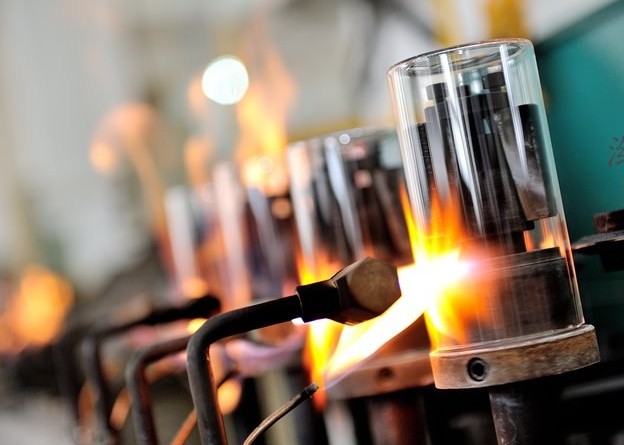
One is machine blowing. The main equipment is bottle making machine or cup blowing machine. It uses the plasticity of glass liquid to blow glass liquid into shape by high pressure gas.  

The other is hand blowing. This craft uses a steel pipe of suitable thickness to carry the glass liquid to one end of the steel pipe. The other end of the pipe is blown by the worker with his mouth. The glass liquid is blown into bubbles, then dipped in the glass liquid again to continue blowing, and then into the mould forming. This process is called hand blowing.

Related News
Read More >>
The Paradox of Toughness: How Tempered Glass Turns Internal Tension into Everyday Safety The Paradox of Toughness: How Tempered Glass Turns Internal Tension into Everyday Safety
Nov .24.2026
The history of colorant glass is often told through the great stained-glass windows of the Middle Ages, when Gothic architecture created vast openings that demanded glass in every hue the medieval palette could supply. The technique was called “pot metal” glass: metal oxides were added directly to the molten glass in the melting pot, and the resulting sheets were cut and assembled in lead frames. Ruby red was so deeply colored that it was nearly opaque, so glassmakers developed flashing—dipping a bubble of clear glass into molten ruby glass to create a thin red coating, then grinding away portions to let light through in intricate patterns. It was a solution born of necessity, and it produced some of the most luminous effects in the history of the craft.
The Alchemy of Color: How Metal Oxides Turn Sand into Stained Glass, Ruby Red, and Cobalt Blue The Alchemy of Color: How Metal Oxides Turn Sand into Stained Glass, Ruby Red, and Cobalt Blue
Nov .24.2026
For most of human history, the color of glass was a mystery. When the first glassmakers in Mesopotamia fired their furnaces roughly 4,000 years ago, they had little idea what hue would emerge until the melt cooled. Color was an accident—a happy one, sometimes, and a costly one at others. It took centuries of trial, error, and a fair amount of alchemical speculation to understand a deceptively simple truth: the vivid blues, rubies, and ambers of colored glass come from the same stuff that makes rocks and ores—metals.
Libbey: The Glassmaker That Built American Drinking, Then Learned to Disappear Libbey: The Glassmaker That Built American Drinking, Then Learned to Disappear

Nov .24.2026
If you have ever ordered a pint in an American bar, there is a strong chance the glass in your hand was made by Libbey. The company has been manufacturing in the United States for over 200 years, and its commercial lines are the default choice in foodservice for a reason that has nothing to do with glamour: consistent quality, deep inventory, and replacement stock that is always available.
Hot Cut vs. Cold Cut: What a Glass Rim Really Tells You Hot Cut vs. Cold Cut: What a Glass Rim Really Tells You
Nov .24.2026
Most people never think about the rim of a glass—until it touches their lips. That last millimeter of glass is the only part of the vessel that makes direct contact with you, and the way it was finished shapes everything from how a drink flows to how long the glass survives in daily use. In glassware manufacturing, two rim-finishing methods dominate: hot cut and cold cut. They look different, feel different, and serve very different purposes.