


The material of a glass decanter directly affects its safety, durability, and potential influence on the flavor of the wine. High-quality glass decanters usually adopt lead-free glass. Lead glass was once widely used due to its good refractive index and luster. However, studies have found that lead may leach out under certain conditions, posing a hazard to human health, especially with long-term use. Lead-free glass avoids this risk and conforms to modern health and environmental protection consumption concepts. Additionally, lead-free glass has high transparency and gloss, enabling a clear display of the color and texture of the wine, allowing you to fully appreciate the visual charm of the fine wine during the decanting process.
When evaluating the glass material, attention should also be paid to its thickness and uniformity. A glass decanter with an appropriate thickness is more robust and durable, less likely to break or crack easily upon slight impact. Meanwhile, a uniform glass thickness ensures that the decanter expands or contracts evenly when the temperature changes, reducing the possibility of damage caused by uneven internal stress. Gently tapping the decanter with your hand, if it emits a clear and pleasant sound, it usually indicates that the glass material is uniform and of good quality; if the sound is dull or has noise, it may suggest that there are thickness irregularities or flaws in the glass.

The shape design of a decanter is a crucial factor affecting its decanting effect and ease of use. There are several common shapes of decanters, among which the classic "swan neck" shape is widely popular. The bottom of a decanter with this shape is relatively wide, providing a large oxidation surface area for the wine, which is beneficial for accelerating the contact between the wine and air and promoting the rapid release of aroma. The gradually narrowing neck can effectively control the flow rate of the wine when pouring, avoiding wine splashing, and reducing excessive contact between the wine and air to prevent the aroma from dissipating too quickly.
In addition to the traditional "swan neck" shape, some decanters feature unique designs. For example, those with built-in diversion devices or special textures. These designs aim to further optimize the flow and oxidation effect of the wine during the decanting process. The built-in diversion device can guide the wine to form a specific flow pattern, increasing the degree of mixing between the wine and air; the texture on the inner wall can make the wine generate more tiny vortices during the flow, accelerating the oxidation reaction. However, when choosing such a specially designed decanter, it is necessary to ensure that its internal structure is not overly complex to avoid difficulties in cleaning, which may lead to bacteria growth and affect subsequent use.
The overall shape of the decanter should also consider ergonomic principles for easy gripping and operation. The handle design should fit comfortably in the hand, making the pouring process more stable and smooth. Some decanters have a weighted or non-slip bottom, enhancing their stability on the table and reducing the risk of accidental tipping.
The capacity of a decanter needs to be selected according to personal usage needs and habits. Generally, the standard capacity of a wine bottle is 750 milliliters. Therefore, the capacity of a decanter is usually between 500 milliliters and 2000 milliliters, which is more common. For daily household use or small gatherings, a decanter with a capacity of around 750 milliliters to 1500 milliliters can basically meet the requirements. Such a capacity can not only fully accommodate a bottle of wine for decanting but also does not occupy too much table space.
If you often host large banquets or have a rich collection of wines, you may need to consider a decanter with a larger capacity, such as a model of 2000 milliliters or more. Large-capacity decanters can handle multiple bottles of wine simultaneously, facilitating you to serve well-decanted fine wines to numerous guests at a party. However, large-capacity decanters may be relatively inconvenient in operation and storage and require more space for placement and cleaning.
In addition, some small decanters with a capacity below 500 milliliters also have their unique uses. They are suitable for decanting a small amount of rare or high-vintage wines, enabling precise control of the decanting time and oxidation degree, avoiding waste or excessive flavor changes due to over-decanting.
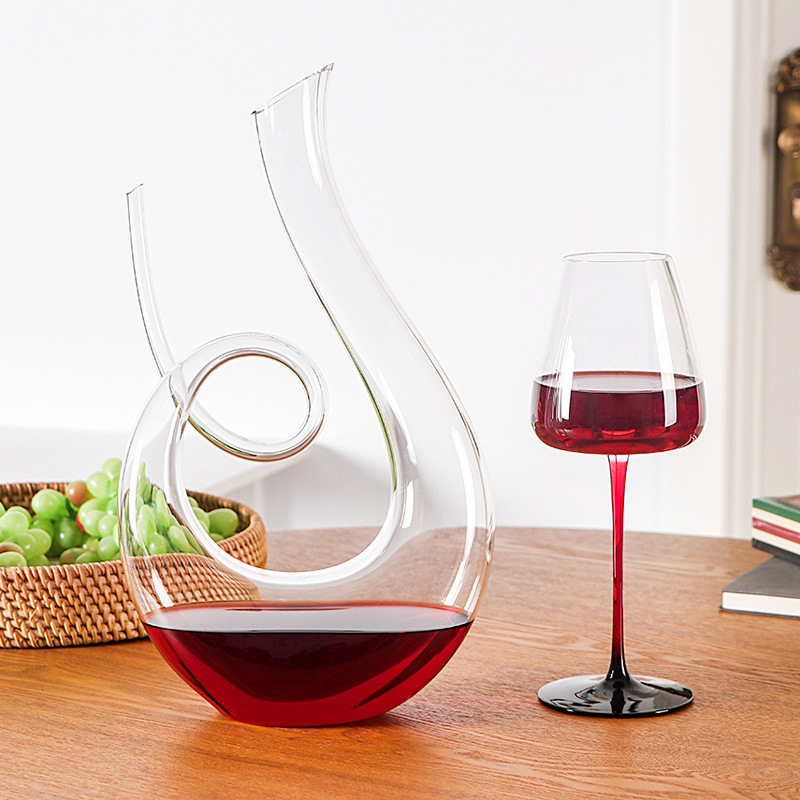
The brand, to a certain extent, reflects the quality and reputation of a glass decanter. Well-known brands usually have stricter production processes and quality control systems. Their products have a high standard in material selection, manufacturing process, and design innovation. Choosing a decanter from a well-known brand can increase the probability of purchasing a high-quality product and also enjoy better after-sales service and product guarantee.
However, price is not the only criterion for measuring the quality of a decanter. There are many glass decanters in the market that are affordable yet of good quality. They may come from some emerging brands or manufacturers that focus on cost performance. When selecting, one should not blindly assume that a high price indicates excellent quality, nor should one overlook some products with good cost performance due to a low price. You can comprehensively evaluate decanters of different brands and price ranges by reading product reviews, consulting professionals, or referring to the usage experiences of other consumers to find the most suitable choice for yourself.
In addition to the above main factors, there are some other details worthy of attention when choosing a glass decanter. For example, the sealing property of the decanter. Good sealing can prevent the wine from excessive oxidation or volatilization during the decanting process, maintaining the stability of its flavor. Check whether the stopper or lid of the decanter fits tightly and whether there is any air leakage. Some decanters use cork stoppers or silicone stoppers, which can provide a good sealing effect without adversely affecting the taste of the wine.
The ease of cleaning of the decanter should not be ignored. Since wine contains tannins, pigments, and other substances, it is prone to leaving stains on the inner wall of the decanter. If not cleaned thoroughly, it will not only affect the appearance of the decanter but also may breed bacteria and affect the quality of the wine during the next use. Therefore, choosing a decanter with a larger opening and a relatively simple internal structure will be more convenient for cleaning. Some decanters can be paired with special cleaning brushes or cleaners to further facilitate users' cleaning and maintenance.
In addition, the appearance design and personal aesthetic preference are also important considerations. There are various styles of glass decanters in the market, ranging from simple and modern to classical and gorgeous, from transparent and colorless to colorfully decorated. You can choose a decanter with an exterior shape and color combination that satisfies you according to your home decoration style, usage scenario, and personal taste, making it a beautiful landscape at home or at a banquet.
In conclusion, selecting a glass decanter requires comprehensive consideration of material quality, shape design, capacity, brand, price, and many other detailed factors. Only by comprehensively weighing these aspects can one choose a glass decanter that is both practical and beautiful and can perfectly enhance the wine tasting experience, making every moment of savoring fine wine more wonderful and memorable.
 Handmade vs. Machine-Made Glassware: Which One Should You Choose?
 The Unassuming Brilliance of the Glass Cup
Behind the Sparkle: The Craftsmanship of Libbey Glassware
The Unassuming Brilliance of the Glass Cup
Behind the Sparkle: The Craftsmanship of Libbey Glassware
 Tempered Glass


Guangzhou HeXie Glass Co., Ltd.
Address: No. 22, Building 53, Haotai Hotel Supplies Expo City, Yingbin Road, Luopu Street, Panyu District, Guangzhou
Tel: +86-18011970645
Email: info@hexieglass.com
https://www.hexieglass.com


